Bubble Trouble:
Making Sense of the AI Economy
Everyone is asking whether AI is a bubble. This hour explains why that question has no tidy answer: economics, geopolitics, information warfare and military competition are all tangled together.
Figures in this deck are from 2024 to 2025 reporting; markets move fast, so treat every number as a snapshot, not a forecast.
"Is AI a bubble?" can't be answered by stock prices alone
Treat it like any market story
Watch the share prices, compare the price-to-earnings ratios, wait for the correction. That works for ordinary manias; tulips, railway shares, crypto tokens.
Four stories tangled into one
Governments frame AI as national security, which keeps money flowing regardless of commercial returns. The same tools reshape the information environment that investors rely on. Each dimension feeds the others.
A buildout with no historical precedent
Record spending, record losses
The money going in circles: hyperscalers buying from each other
Every arrow is a real, announced deal
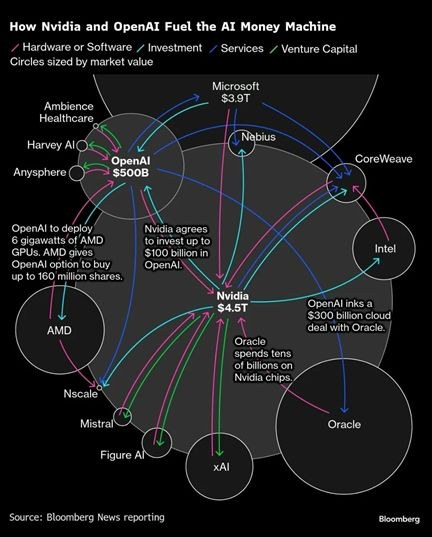
Circles are market value. Nvidia at $4.5 trillion, Microsoft at $3.9 trillion, OpenAI at $500 billion. The arrows are what they have agreed to pay or invest in each other.
Follow one loop. Nvidia agrees to invest up to $100 billion in OpenAI; OpenAI signs a $300 billion cloud deal with Oracle; Oracle spends tens of billions on Nvidia chips. The money comes back around.
None of this is illegal or even unusual on its own. The question a picture like this raises is the one from the last slide: how much of the demand is coming from outside the circle?
Chart: Bloomberg News, from "OpenAI's Nvidia, AMD Deals Boost $1 Trillion AI Boom With Circular Deals", 7 October 2025, bloomberg.com. The graphic itself carries no date, only the credit "Source: Bloomberg News reporting"; the figures are those reported at the time of publication and have moved since. Reproduced here for teaching and comment.
What makes a problem "wicked"?
A "wicked problem" in policy terms is a challenge that resists simple solutions. The AI bubble ticks every box:
Four dimensions, deeply intertwined
The money
Investment flows, market valuations, circular financing, and the awkward question of when returns arrive.
The great powers
US-China competition, chip export controls, supply chain choke points and strategic autonomy.
The stories
Misinformation amplification, algorithmic curation, and narrative warfare about what AI can actually do.
The arms race
Autonomous systems, intelligence analysis, and deterrence calculations that don't care about quarterly earnings.
A supply chain with three choke points
TSMC
Manufactures roughly 90% of the world's most advanced chips. There is no quick substitute anywhere on earth.
NVIDIA
Dominates the AI accelerator market; the US uses export controls on these chips to slow China's AI development.
ASML
The sole supplier of the extreme ultraviolet lithography machines needed to make advanced chips at all.
The same technology is rewiring what we believe
Researchers describe three interconnected actors in misinformation spread; AI turbocharges all of them, plus the tools meant to catch it:
Making it is now cheap
AI slashes the cost of producing false content: fake articles, deepfake video, synthetic audio.
Telling is now hard
Individuals increasingly cannot distinguish AI-generated content from authentic material, especially under stress or cognitive load.
Spreading is the business
Engagement-optimised algorithms promote sensational and divisive content; misinformation included.
The referee hallucinates
AI-based detection delivers mixed results, and AI's own hallucinations mean it can't be trusted to fact-check itself.
An arms race that doesn't read earnings reports
Every AI claim has a beneficiary
"AI changes everything, invest now"
AI companies attracting investment and justifying valuations · defence contractors securing funding · governments justifying security spending and deterring adversaries · content creators farming engagement from hype.
"It's all hype, stay away"
Short sellers profiting from falling valuations · competitors undermining rivals' perceived lead · safety researchers wanting development slowed · threatened industries defending existing business models.
Each dimension amplifies the others
The people selling the boom keep saying "bubble"
The dot-com bubble: the technology was real anyway
1999 to 2000
Revolutionary technology, massive investment, circular financing between firms; then a 78% collapse in the NASDAQ. The internet still changed the world; most of the 1999 companies didn't live to see it.
Fibre then, data centres now
As author Bethany McLean notes, the 1990s fibre-optic overbuild left infrastructure that sat unneeded for decades. Today's question: will the current data centre boom rhyme with that; useful eventually, ruinous for whoever paid?
Bubble dynamics reach the Territory in five ways
Reading the AI economy without panic
Where this deck's claims come from
Prepared August 2026 for the NT World Ink AI Special Topic Workshops, from the NT World Ink research file on the AI bubble. Market figures age quickly; treat them as a late-2025 snapshot.