Can AI Read My Handwriting, and Understand My Voice?
Short answer: yes, remarkably well; and imperfectly, in ways worth understanding. This tool walks through what actually happens when you upload a handwritten page or a voice memo to an AI: where the file goes, how it gets read, why messiness turns into errors, and one thing every researcher should know before uploading anything.
// part one
Reading your handwriting
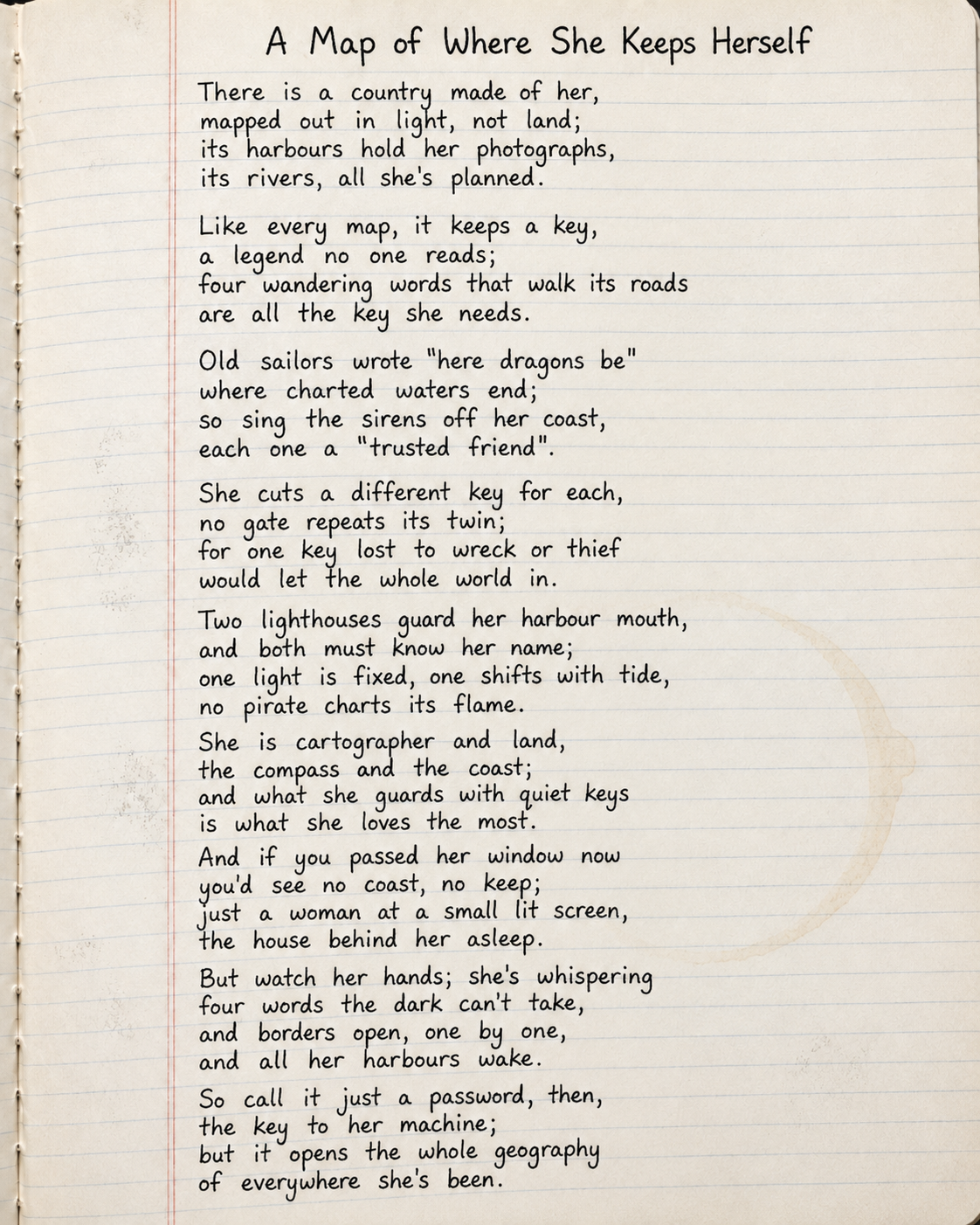
Here is a poem, handwritten into a notebook three times: neatly, in a hurry, and messily, complete with crossed-out corrections and a coffee stain. These are real scanned pages, not fonts. Choose a version, then upload it and watch what the machine does with it.
Step 1 · The page
Step 2 · Where the page goes
Your photo does not get read by your phone. It travels:
01Your deviceThe page becomes a photo: just a grid of coloured dots (pixels).
→
02The internetThe photo is sent, usually encrypted, to the AI company's servers.
→
03A data centreOften overseas: commonly the United States, sometimes China, depending on whose tool it is.
→
04Back to youOnly the finished text comes home. The processing happened over there.
Hold that thought; it becomes important in Part Three.
Step 3 · Inside the machine: OCR
The technical name for this is OCR: Optical Character Recognition. "Optical" because it works from the image, "character recognition" because its job is turning shapes into letters. Watch it work:
Step 4 · What came back
Dotted words are the machine's confident guesses; hover or tap them to see what was really written. Notice the errors are real words, not gibberish; the final step guesses from context, so OCR mistakes look plausible, which is exactly why they slip through unchecked. Crossed-out corrections, underlines and stains are classic OCR traps; each produces its own style of error.
// part two
Understanding your voice
Now the same journey for sound. Here is a voice memo recorded after a morning site inspection. Choose the recording conditions, then send it off for transcription.
Step 1 · The recording
site-notes-tuesday.m4a0:19 · VOICE MEMO
Step 2 · Inside the machine: speech-to-text
This one is called speech-to-text (engineers say ASR, automatic speech recognition). The recording makes the same overseas journey as the photo did, then:
Step 3 · The transcript
Notice what struggled even in the clean recording: the surname. Speech models learn from enormous amounts of recorded English, most of it American and British, so unfamiliar names, place names and strong accents are exactly where transcription is least reliable; worth knowing before you trust an auto-transcript of anything.
// part three
One more thing: where did your file actually go?
Both uploads made the same trip: your device, the internet, and then a data centre that is usually not in Australia. Most of the popular AI tools process uploads in the United States; some are run by Chinese companies and process them in China. The finished text comes back to your screen; the file itself made an international journey to get read.
It left the country
Assume anything you upload to a free public AI tool is processed overseas, under that country's laws, on that company's servers.
Free tools may keep it
Many free tiers can store what you upload and use it to improve their models. Paid and workplace versions often promise not to; the settings and terms differ tool by tool.
So choose what you upload
Shopping lists and your own drafts: fine. Interview recordings, patient information, cultural knowledge, other people's voices: stop and use the approved tool for that work, or don't upload at all.
The question is never just "can the AI read this?" It is also "who else is holding it while the AI reads it?"
// the verdict
So: can it?
Yes, it can read
Trained on enormous amounts of text and imagery, OCR reads reasonably neat handwriting well, and speech-to-text handles clear recordings well. These tools are useful, and getting better.
Messiness becomes errors
Scrawl, background noise, crosstalk, accents and unfamiliar words all push the machine into confident guessing. Teaching a model every handwriting style and every voice on earth is extremely hard; the long tail never ends.
So always check the output
Errors come back as plausible words, not obvious garbage. Anything that matters (names, numbers, quotes, medication doses) gets read by a human before it gets used.
// glossary
Glossary
OCR (Optical Character Recognition): software that turns an image of writing (typed or handwritten) into editable text.
Speech-to-text / ASR (Automatic Speech Recognition): software that turns recorded speech into written text.
Pixels: the grid of coloured dots that make up a digital photo; all the machine ever "sees".
Segmentation: the step where the machine finds the lines, words and letter shapes on the page before trying to read them.
Confidence score: the machine's own estimate of how sure it is about each word; low confidence is where to look first for errors.
Data centre: the warehouse of computers, often overseas, where uploads are actually processed.